Behind every sharp, consistent print lies a carefully maintained screen. A range of specialized chemicals is used at each stage of the screen’s lifecycle – from preparation before coating to reclaiming the mesh for reuse. These chemicals ensure optimal emulsion adhesion, stencil integrity and mesh longevity, directly impacting print quality and operational efficiency.
Hardener
Screen printing hardener is a chemical post-treatment applied to a fully exposed and developed stencil to dramatically increase its resistance to aggressive inks, solvents and water-based media. By chemically cross-linking the cured emulsion polymer chains further, hardener converts a standard stencil into a near-permanent one capable of withstanding very long print runs and harsh ink chemistries. It is particularly recommended when printing with solvent-based, UV-curable, or aggressive water-based inks. Note that hardened stencils become extremely difficult – sometimes impossible – to reclaim, so hardener should only be applied when a screen is dedicated to a recurring job or long production run.
Degreaser
Degreaser is a preparatory chemical applied to a clean, bare mesh screen before emulsion coating. Even a brand-new or freshly reclaimed mesh can carry invisible contaminants – oils from handling, dust, or residual chemical traces – that prevent emulsion from bonding uniformly to the mesh threads. Poor adhesion results in pinholes, weak stencil edges and premature breakdown during printing. Degreasers are typically mild, water-based alkaline formulations that are applied to both sides of the screen, scrubbed lightly with a soft brush and thoroughly rinsed. Once the screen is degreased and dried in a dust-free environment, it is ready for emulsion coating. Using a degreaser every time before coating is a simple step that significantly improves stencil quality and print consistency.

Decoater (Emulsion Remover / Stencil Stripper)
Decoater – also called emulsion remover or stencil stripper – is used to chemically dissolve and remove the hardened emulsion stencil from the mesh after a print job is completed, allowing the screen to be reused. It is applied to both sides of the screen, allowed to penetrate the hardened emulsion for a short dwell time and then pressure-washed away along with the emulsion residue. High-quality decoaters work on all standard emulsion types – diazo, dual-cure and photopolymer – and are formulated to be safe on polyester mesh while being effective on the stencil. Efficient decoating is economically critical since screens represent a significant capital investment and their ability to be reclaimed and reused many times directly reduces operational cost.
Anti-Ghost Rapid Gel (Haze Remover)
After a stencil has been stripped with decoater, a faint shadow of the previous design – known as a ghost image or ink haze – often remains embedded in the mesh threads. This occurs because ink pigments and emulsion residues penetrate deep into the mesh structure and resist standard cleaning. If not removed, ghost images cause visible haze and bleed-through on subsequent prints, compromising quality. Anti-ghost rapid gel (haze remover) is a concentrated, high-powered formulation specifically designed to dissolve these stubborn pigment stains and emulsion traces. Applied to both sides of the damp screen and scrubbed lightly, it restores the mesh to a clean, open, print-ready state. Regular use of anti-ghost gel extends the usable life of screens and ensures every new stencil performs on a truly clean substrate.

Frame Adhesive
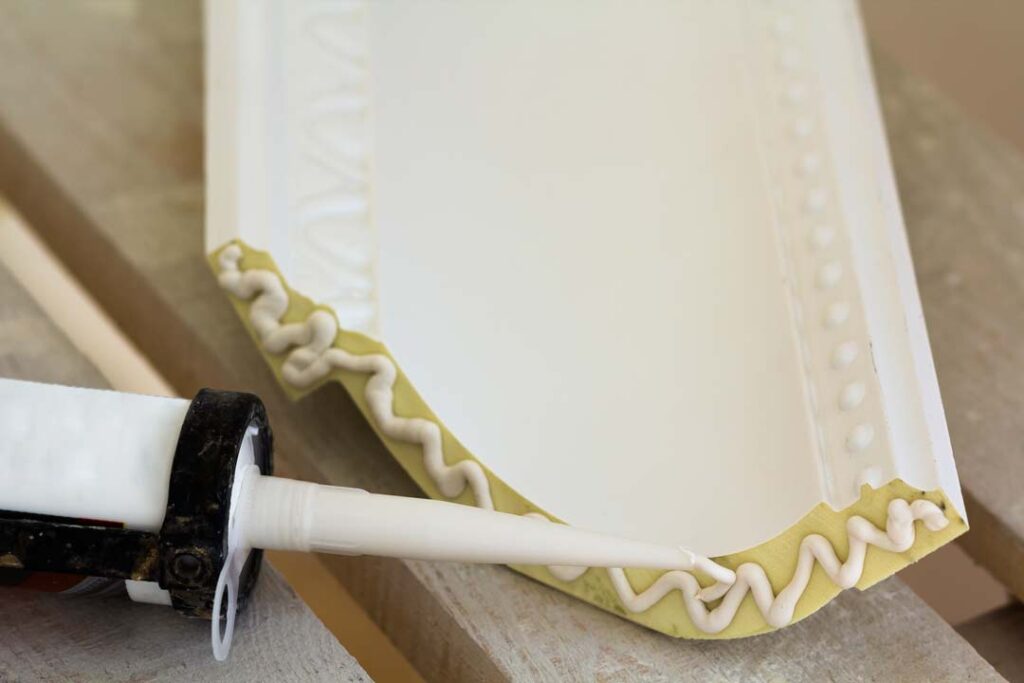
Frame adhesive is the bonding agent used to permanently attach the screen mesh to the printing frame. In screen printing, the mesh must be stretched to a precise, even tension before being glued to the frame – typically an aluminium or wooden profile. A high-quality frame adhesive creates a strong, chemically resistant bond that holds the mesh at the correct tension throughout the screen’s working life, even when exposed to inks, solvents and repeated washing. Two-component epoxy adhesives are the professional standard, offering excellent resistance to chemicals and temperature variations. Proper bonding is essential: a screen with poorly attached mesh will lose tension unevenly, causing misregistration and inconsistent ink deposit across the print area.
Green and Brown Lacquer
Screen lacquers – available in green and brown formulations – are liquid masking products brushed or sprayed onto the non-printing areas of a screen to seal any open mesh outside the stencil image area. Green lacquer (water-based) is used for sealing screens that will be used with plastisol or water-based inks, providing a flexible, paintable barrier that is easy to remove for screen reclaiming. Brown lacquer (solvent-based) offers superior chemical resistance and is preferred when printing with aggressive solvent-based or UV-curable inks where water-based masking would break down. Both lacquers protect the frame and non-image areas from ink seepage, ensure clean print borders and prevent ink from contaminating the underside of the print bed.